
Why CodonRX Uses Pharmaceutical-Style Blister Packs
Posted by The CodonRX Science Team on Jul 13th 2026

Open a bottle of almost any probiotic on the market and you’ll find the same thing: a wide-mouth jar, a foil seal you break once, and a loose pile of capsules that will share that jar’s air for the next 30, 60, or 90 days. Pop the cap to take your daily dose, and the capsules left behind get another dose of something else — humidity, oxygen, light, and whatever temperature your bathroom cabinet happens to be that day.
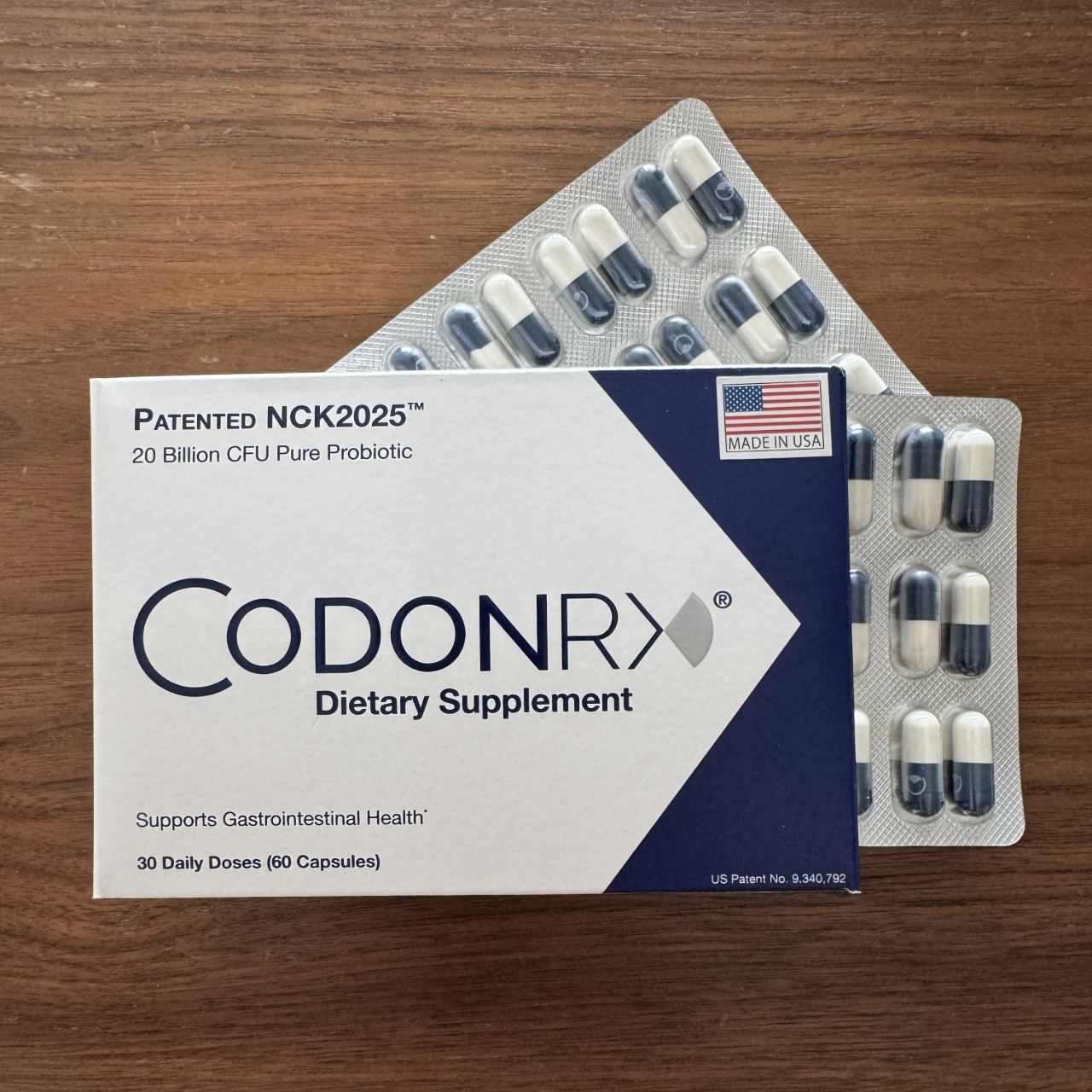
CodonRX® doesn’t ship that way. Every capsule sits in its own individually sealed cavity inside a blister card, isolated from the outside world — and from every other capsule — until the moment you push it through the foil. That’s not a cosmetic packaging choice. It’s a deliberate decision to package CodonRX® to the same standard used in pharmaceutical and clinical dosing, rather than the standard the supplement industry defaults to.
The Problem With Sharing a Bottle
Probiotics are live cultures. Lactobacillus acidophilus — the organism behind CodonRX®’s patented NCK2025™ strain — is a living microorganism, and living microorganisms are sensitive to their environment. Three things degrade probiotic potency over time: moisture, oxygen, and temperature fluctuation. A bottle format exposes capsules to all three, repeatedly, for the entire life of the product.
Here’s the mechanism: every time a bottle is opened, ambient humidity and oxygen rush in and settle over whatever capsules remain. Close the cap, and that exposure doesn’t reset — it accumulates. A bottle used once a day for 30 days delivers 30 separate exposure events to the capsules still inside it, and the capsules taken later in the cycle have absorbed more cumulative environmental stress than the ones taken on day one. The number on the label reflects what was true at the moment of manufacture. What actually reaches your gut depends on how well the packaging held that number intact.
CFU — colony-forming units — is the standard measure of live, active bacteria delivered in a probiotic dose. It’s the number every probiotic label leads with.
CodonRX®’s product page puts it plainly: “Most probiotic bottles lose potency every time you open them. CodonRX® ships in individually sealed blister packs that protect each capsule from humidity, oxygen, and temperature fluctuations — right up to the moment you take it. The 20B CFU on the label is what reaches your gut.”
A blister pack sidesteps this entirely because there’s no shared airspace to begin with. Each capsule is sealed into its own cavity at the point of manufacture, with a foil backing that isn’t broken until you personally push that one capsule through. The capsule you take on day 28 has been exposed to exactly the same conditions as the one you took on day one — none, until you break its seal. That’s the structural difference: a bottle protects the batch until first use; a blister card protects every single dose until its own use.
- Sealed at the point of manufacture — no repeated exposure from a shared bottle every time the container is opened
- Moisture and oxygen barrier maintained until use — protecting live cultures through the full shelf life, not just until first opening
- Precise, isolated dosing every time — no capsule contact with other capsules or with the surrounding environment
Why Almost No Other Probiotic Brand Does This
If blister packaging protects potency this effectively, a reasonable question is why more probiotic brands don’t use it. The honest answer is that it costs more, it’s more complex to manufacture, and the category has never demanded it. Based on our own packaging review of more than 20 premium probiotic brands, blister carding is close to nonexistent in this space — bottles are the near-universal default, even among brands that otherwise compete heavily on science and formulation. That makes blister carding a genuine outlier in the premium probiotic category, not an industry norm CodonRX® happens to follow.
What the Format Signals
- Blister carding is standard in pharmacy and clinical dosing — not a typical supplement-industry packaging choice
- Each capsule is isolated in its own sealed cavity, protected from humidity, oxygen, and temperature until the moment it’s used
- Blister carding is nearly nonexistent among premium probiotic brands — our own review of 20+ brands found it’s not the category norm
- CodonRX® ships as two 30-capsule blister cards per 30-day, 60-capsule supply — two capsules daily
What This Means for the Capsule You Actually Take
CodonRX®’s active ingredient is Lactobacillus acidophilus NCK2025™ — a patented, precision-engineered strain developed over 40+ years of research at NC State University, delivered at 20 billion CFU per serving and protected by U.S. Patents 9,340,792 and 9,980,992. That strain, and the research behind it, is the reason someone chooses CodonRX® in the first place. Packaging is what makes sure the capsule you swallow on day 25 still delivers what the label promised on day one.
A supplement is only as good as what actually survives to the moment you take it. Precision engineering at the strain level and precision packaging at the dose level are solving the same problem from two different directions — one protects the biology of the organism, the other protects the physical integrity of every individual dose. CodonRX® is one of the only products in its category built to do both.
CodonRX® ships as two individually sealed, clinically-packaged blister cards — not a bottle you open and reopen for 30 days straight.
Patented NCK2025™ · 20B CFU per serving · Pharmaceutical-grade packaging built to protect every dose.
Shop CodonRX® 30-day supply · Patented NCK2025™ · Made in the USAThese statements have not been evaluated by the Food and Drug Administration. This product is not intended to diagnose, treat, cure, or prevent any disease. CodonRX® is a dietary supplement, not a pharmaceutical drug; references to “pharmaceutical-grade” or “clinical” packaging describe the packaging format and dose-protection standard only, not a drug classification or regulatory status.